Let's Talk!
Our multidisciplinary team combines deep industry expertise with proven methodologies to deliver transformational outcomes. We partner with ambitious organizations to unlock sustainable growth and operational excellence.

The Mission Delivery Model: The Strategic Choice for Survival
The world that non-profit organisations (NPOs) operate in has been irrevocably altered.
Perpetual fiscal constraints, mounting demands for transparency, and the pressure of
maintaining a broad geographical reach have rendered the traditional operating model—the
deeply integrated, "Go It Alone"; approach—strategically untenable. Today, the most vital
decision facing any NPO leader is not about mission purpose, but about operational structure:
how can the organisation sustainably deliver its mission while mitigating mounting
operational risk? This question demands a discerning, strategic answer that moves beyond
simple cost-cutting and focuses on true resource optimisation.
The concept of the Redwood provides a powerful metaphor for the traditional model. The
Redwood is admired for its solitary majesty and singular scale, representing the NPO that
owns and operates all functions—from accounting to programme delivery—in-house. While
this grants maximum internal control, this vertical integration requires immense, diversified
resources to sustain. This structure quickly becomes a strategic liability given the rising
complexity of international compliance. For example, maintaining local accounting expertise
to manage statutory filing changes across multiple nations, from Nigeria to Kenya, becomes a
costly burden that drains mission funds away from essential programmes.
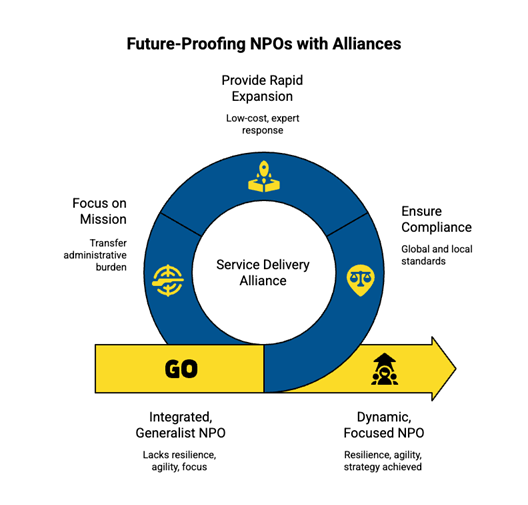
The forward-thinking solution lies in embracing the principle of the Strategic Alliance. This
approach recognises that strength comes not from self-sufficiency in all areas, but from a
secure, specialised ecosystem of partners. This introduces the core operational choice facing
the executive: the choice between the "Go It Alone"; approach, Sector-Specific Alliances,
Merger and Consolidation, and the Service Delivery Alliance. The Service Delivery Alliance
represents a formal, operational relationship designed to share functions, technology, or
highly specialised expertise. This strategic partnership mitigates the risk and cost associated
with managing diverse local compliance requirements, allowing the NPO to focus on core
programme delivery.
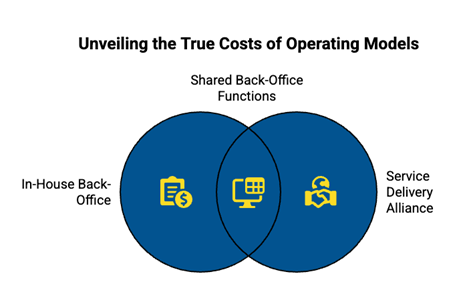
The financial trade-off is clear: the high, variable cost of internal generalism is rapidly
outpacing the strategic value of internal control. Furthermore, aligning with emerging global
financial standards, such as the principles of the International Non-Profit Accounting
Standard (INPAS), requires a unified, high-level of expertise that is difficult and expensive to
replicate internally in every country of operation. The Service Delivery Alliance provides this
expertise at scale.
The era of the "Go It Alone" NPO is drawing to a close. The modern strategic
imperative is to choose a delivery model that converts high-risk administrative cost centres
into secure, expert-managed functions. The NPO that strategically partners, leveraging the
efficiencies and specialisation of the Service Delivery Alliance, is the one that builds a
foundation resilient enough to support sustained, focused programme growth in an
environment that demands both agility and compliance. The future of the mission depends on
this foundational, structural choice.