Let's Talk!
Our multidisciplinary team combines deep industry expertise with proven methodologies to deliver transformational outcomes. We partner with ambitious organizations to unlock sustainable growth and operational excellence.

The Future of Volunteering: Bridging the Gap in a Changing World
A Shifting Global Landscape
The international development landscape is undergoing a severe contraction as several developed nations cut their overseas development assistance (ODA) contributions. As traditional, large-scale funding streams retract—vividly illustrated by recent shocks such as PEPFAR funding withdrawals and widespread funding allocation reductions by the Global Fund to Fight AIDS, Tuberculosis and Malaria —governments and development institutions are being fiercely tested.
To bridge this widening gap, the work by global entities such as the United Nations Volunteers (UNV) and VSO highlight that volunteering is no longer just a charitable act; it is a resilient engine for sustainable development. Globally, an estimated 2.1 billion people volunteer their time every month, forming a crucial human infrastructure that sustains global progress.
The Spirit of Ubuntu
In Africa, volunteering is deeply rooted in the philosophy of Ubuntu—the cultural recognition that mutual aid and solidarity are essential for human existence. According to a five-country study by VOSESA, volunteering here often involves the "poor serving the poor," where volunteers and beneficiaries share similar socio-economic hardships.
In South Africa, this plays out against a backdrop of severe economic inequality. According to a Volunteer Activities Survey conducted by Statistics South Africa, the typical volunteer is a young African female, aged 25–34, driven not only by a moral obligation to their communities but by real economic need. Volunteering is viewed as a vital stepping stone to acquire skills, build networks, and enhance their employability in the formal labour market.
The Value of Community and Corporate Volunteers
Community-based volunteers provide a vital safety net where state provision is limited, delivering essential services in health and education to build local resilience. Simultaneously, the private sector is stepping in to bridge funding gaps. Corporate volunteering, driven by corporate social investment (CSI) initiatives, allows professionals to transfer highly specialised skills to under-resourced community organisations. Corporate volunteering pioneers in South Africa, such as the FirstRand and Discovery, demonstrate how aligning CSI spending with structured employee volunteering can empower communities while boosting staff morale and leadership skills.
The UNV GIVE Metrics
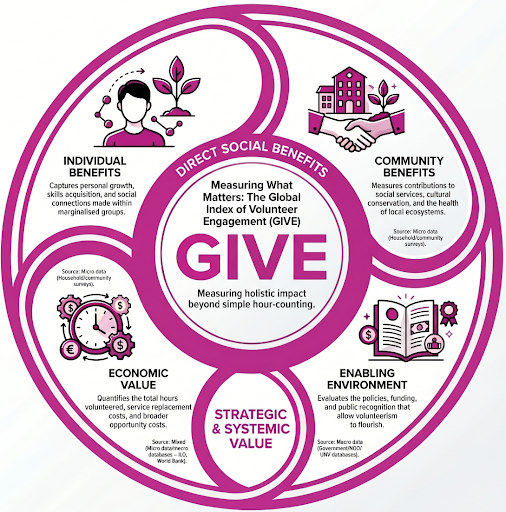
To secure future investment, we must move beyond merely counting the hours volunteers work. According to the 2026 State of the World’s Volunteerism Report, UNV and the University of Pretoria have developed the Global Index of Volunteer Engagement (GIVE). This framework offers a revolutionary way to measure impact across four core dimensions.

Figure 1: UNV GIVE metrics
Capitalising on Volunteering
To truly capitalise on volunteering and offset the withdrawal of major international aid, we must adopt sustainable strategies:
Link Volunteering to Employability: We must formally recognise and certify the skills young volunteers acquire, ensuring their time spent serves as a tangible bridge to employment.
Support the Volunteer: Because many volunteers come from impoverished backgrounds, providing stipends or reimbursing out-of-pocket expenses is critical to ensure volunteering does not become an economic burden.
Leverage Cross-Sector Partnerships: Governments and civil society must actively partner with the private sector, using CSI to sustainably fund community-level volunteer networks.
By adopting these strategies and the GIVE metrics, we can translate the invaluable work of volunteers into actionable data, proving that when financial aid recedes, human solidarity can powerfully bridge the gap.