Let's Talk!
Our multidisciplinary team combines deep industry expertise with proven methodologies to deliver transformational outcomes. We partner with ambitious organizations to unlock sustainable growth and operational excellence.

The Future of Volunteering: Bridging the Gap in a Changing World
A Shifting Global Landscape
The international development landscape is undergoing a severe contraction as several developed nations cut their overseas development assistance (ODA) contributions. As traditional, large-scale funding streams retract—vividly illustrated by recent shocks such as PEPFAR funding withdrawals and widespread funding allocation reductions by the Global Fund to Fight AIDS, Tuberculosis and Malaria —governments and development institutions are being fiercely tested.
To bridge this widening gap, the work by global entities such as the United Nations Volunteers (UNV) and VSO highlight that volunteering is no longer just a charitable act; it is a resilient engine for sustainable development. Globally, an estimated 2.1 billion people volunteer their time every month, forming a crucial human infrastructure that sustains global progress.
The Spirit of Ubuntu
In Africa, volunteering is deeply rooted in the philosophy of Ubuntu—the cultural recognition that mutual aid and solidarity are essential for human existence. According to a five-country study by VOSESA, volunteering here often involves the "poor serving the poor," where volunteers and beneficiaries share similar socio-economic hardships.
In South Africa, this plays out against a backdrop of severe economic inequality. According to a Volunteer Activities Survey conducted by Statistics South Africa, the typical volunteer is a young African female, aged 25–34, driven not only by a moral obligation to their communities but by real economic need. Volunteering is viewed as a vital stepping stone to acquire skills, build networks, and enhance their employability in the formal labour market.
The Value of Community and Corporate Volunteers
Community-based volunteers provide a vital safety net where state provision is limited, delivering essential services in health and education to build local resilience. Simultaneously, the private sector is stepping in to bridge funding gaps. Corporate volunteering, driven by corporate social investment (CSI) initiatives, allows professionals to transfer highly specialised skills to under-resourced community organisations. Corporate volunteering pioneers in South Africa, such as the FirstRand and Discovery, demonstrate how aligning CSI spending with structured employee volunteering can empower communities while boosting staff morale and leadership skills.
The UNV GIVE Metrics
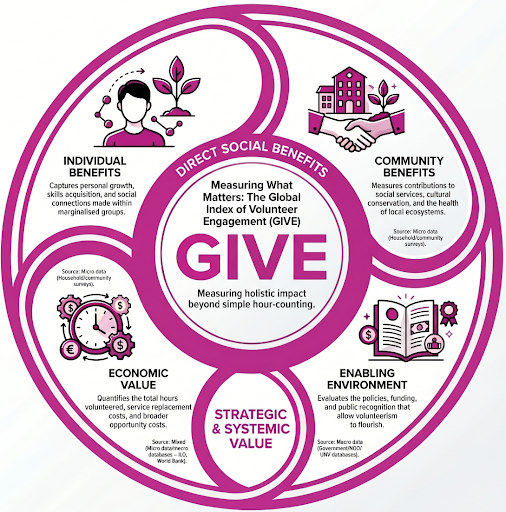
To secure future investment, we must move beyond merely counting the hours volunteers work. According to the 2026 State of the World’s Volunteerism Report, UNV and the University of Pretoria have developed the Global Index of Volunteer Engagement (GIVE). This framework offers a revolutionary way to measure impact across four core dimensions.

Figure 1: UNV GIVE metrics
Capitalising on Volunteering
To truly capitalise on volunteering and offset the withdrawal of major international aid, we must adopt sustainable strategies:
Link Volunteering to Employability: We must formally recognise and certify the skills young volunteers acquire, ensuring their time spent serves as a tangible bridge to employment.
Support the Volunteer: Because many volunteers come from impoverished backgrounds, providing stipends or reimbursing out-of-pocket expenses is critical to ensure volunteering does not become an economic burden.
Leverage Cross-Sector Partnerships: Governments and civil society must actively partner with the private sector, using CSI to sustainably fund community-level volunteer networks.
By adopting these strategies and the GIVE metrics, we can translate the invaluable work of volunteers into actionable data, proving that when financial aid recedes, human solidarity can powerfully bridge the gap.
Partnership: The True Cost Analysis Beyond the Spreadsheet
When evaluating operating models, NPO leaders often fall prey to a flawed "spreadsheet comparison" that only weighs internal salaries against a partnership fee. This comparison ignores the immense hidden costs and risks inherent in the in-house model, particularly those associated with achieving and maintaining global compliance. This superficial analysis can lead to catastrophic strategic mistakes.
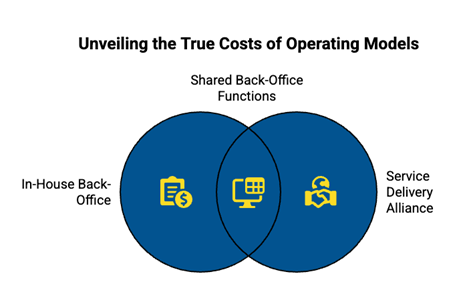
The true cost of an in-house back-office includes the specialised software licences, the cost of continuous staff training on global standards, and the opportunity cost of delayed or incorrect compliance. For instance, the cost of recruiting a qualified, local payroll manager in a competitive city like Lagos, Nigeria, is often significantly underestimated, as is the cost of constantly updating their knowledge of fast-changing tax laws. This internal structure carries high, variable, and often hidden costs.
The Ecosystem metaphor emphasises that strength comes from external, specialised support. A Service Delivery Alliance pools these costs across multiple clients, providing immediate access to the required technology and expert staff already proficient in global best practices. This transforms variable, hidden internal costs into a fixed, predictable, and expertly managed service fee.
This results in superior service, reduced risk, and, ultimately, lower total cost of ownership compared to the high, variable, and often hidden costs of internal generalism. The smart strategic investment is always the one that guarantees mission security and regulatory compliance at scale.
Conclusion: The discerning leader recognizes that the true cost of an operational model is not the price of a salary; it is the cost of risk, lost executive time, and compliance failure. The Service Delivery Alliance is not a cost-cutting measure; it is a strategic investment in predictable, expert-managed security that provides a clear return on investment through risk mitigation and sustained focus on mission impact.
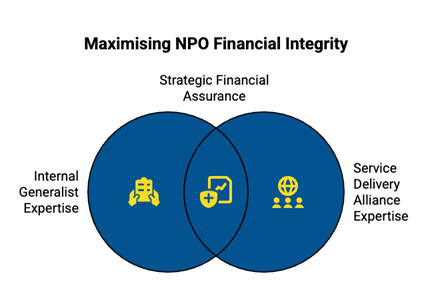
Tax and statutory compliance for NPOs must now be viewed through the lens of global transparency. Tax is not merely an annual filing obligation; it is a fundamental function that acts as a protective shield for the organisation's legal and fiduciary standing. Failure to correctly manage tax across jurisdictions can jeopardise both local compliance and the organisation's global standing.
The Bear's Instinct is self-preservation. For an NPO, this means ensuring that every pound spent is legally defensible and that the organisation’s tax-exempt status is never compromised. This requires specialised expertise in areas like Unrelated Business Income Tax (UBIT), international tax treaties, and state-level registrations.
The problem with the internal generalist is its inability to maintain the required depth of knowledge across multiple jurisdictions simultaneously. Consider the implications of VAT compliance in a country like Botswana or the complexity of withholding tax rules for international staff in a hub like Kenya. The strategic risk of receiving generalised advice in these high-stakes areas is high.
A Service Delivery Alliance provides specialised, multi-jurisdictional expertise instantly. This ensures protection from local fines and provides the strategic certainty needed to manage the organisation’s financial integrity across all operating theatres. By partnering for this function, the NPO gains access to a collective pool of high-level knowledge that no single organisation could afford to staff internally. This strategic certainty fulfils the Bear's instinct for safe and compliant operational planning.
Conclusion: Tax and statutory compliance cannot be delegated to an overwhelmed internal generalist. It is a specialised function that demands continuous investment and expertise. By using a Service Delivery Alliance, NPO leaders secure an expert shield against complex financial and legal risk, ensuring the organisation's resources are legally protected and fully deployed toward the mission.
The Synthesis: The New Operating Imperative
We have dissected the strategic choices facing NPO leaders—from the founding mission delivery model to the complexity of payroll compliance in Senegal. The analysis has been consistent: the era of the fully integrated, generalist NPO is over. The evidence leads to one final, defining conclusion about the operating model required for endurance in this new world.
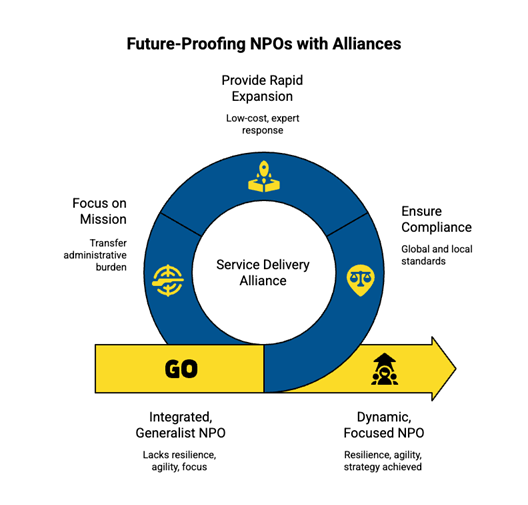
The future NPO must achieve a dynamic balance between resilience, agility, and strategic focus. This synthesis of the Redwood, Seasonal Flower, and Bear is only achievable through the strategic adoption of a Service Delivery Alliance.
The alliance guarantees Resilience by ensuring demonstrable compliance with global standards where relevant, and highly specialised local compliance across diverse regions. It secures Agility by providing rapid, low-cost expansion and expert response to local changes (e.g., labour law updates across Africa). Most importantly, it realises Strategy by focusing internal resources exclusively on mission delivery, transferring the administrative burden to a trusted, expert partner.
The adoption of a specialised Service Delivery Alliance model is the clearest evidence of operational maturity. It proves that the NPO is future-proofing its mission against the volatile economic constraints and complex compliance demands that will characterise the next decade.
Conclusion: The new operating imperative is non-negotiable: non-profit organisations must move from doing everything themselves to leveraging external expertise for non-core functions. This structural change is not a concession; it is a strategic move that enables mission endurance. By securing a Service Delivery Alliance, BMG Partners Inc. enables NPO leaders to make their most powerful strategic statement: that their focus is entirely on impact, sustained by a resilient, expert-managed backbone designed for a world that will never go back to what it used to be.

Refocusing Executive Bandwidth: Strategy or Spreadsheets?
The most valuable, non-renewable resource in any NPO is the Executives’ time. Every hour spent supervising administrative crises, such as interpreting the latest compliance guidance or mediating a payroll error in the field office, is an hour stolen from mission delivery, donor cultivation, and strategic future-casting.
The Bear's Focus is a metaphor for the executive's singular need to concentrate on mission strategy. Implementing complex global frameworks and managing diverse operational issues internally consumes valuable senior management time. For an NPO seeking strategic growth in challenging environments, executive focus is paramount. For example, an Executive Director’s time is far better spent securing new funding relationships in Abidjan than managing tax filings in Accra. This decision about where the CEO spends time is, fundamentally, a structural decision.
The decision to adopt a Service Delivery Alliance is the formal declaration that the organization will no longer compromise its mission for overhead management. The partnership model transfers the burden of operational implementation and ongoing compliance to the specialist, even for highly technical areas like INPAS preparation. This ensures the organization meets its highest fiduciary duties while allowing the CEO's bandwidth to be immediately reclaimed and redirected to where it belongs: securing the future of the mission. The cost of administrative time lost far outweighs the cost of a Service Delivery Alliance.
Conclusion: The goal of operational efficiency is to maximise mission capacity. Strategic leadership means relentlessly eliminating distractions that compromise focus. By using a Service Delivery Alliance, NPO executives effectively transfer administrative turbulence to an expert partner, ensuring their leadership energy is spent on vision, fundraising, and programme impact—the only activities that truly advance the mission.
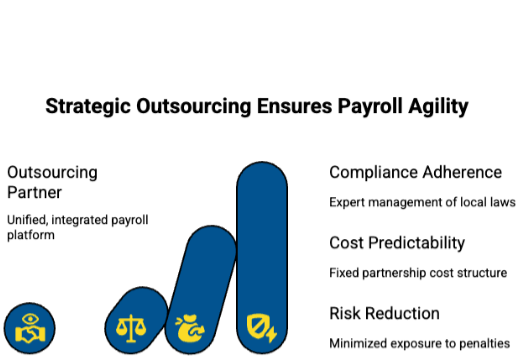
The Payroll Function Decision: Navigating Multi-Jurisdictional Complexity