Let's Talk!
Our multidisciplinary team combines deep industry expertise with proven methodologies to deliver transformational outcomes. We partner with ambitious organizations to unlock sustainable growth and operational excellence.

The Future of Organisational Structure: Shield or Shackle?
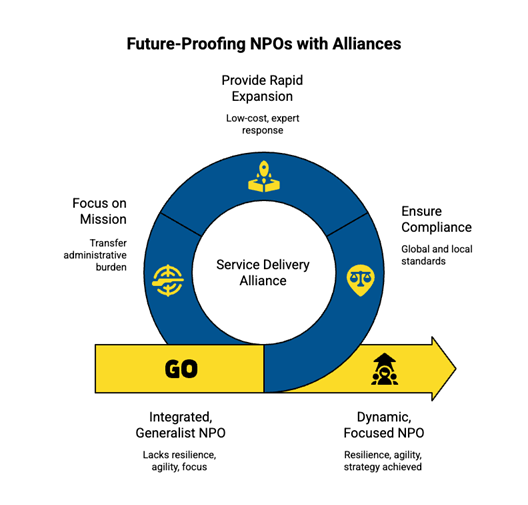
In Article I, I established that the strategic imperative for NPOs is moving away from the costly "Go It Alone" model toward Service Delivery Alliances to mitigate risk and free up resources for core programme delivery. If the delivery model is the foundational choice, the organisational structure is the architecture built upon it.
This architecture whether Centralised, Decentralised, or Hybrid must now be tested against the dual demands of budget constraint and complex global compliance. An organisation's structure is the physical manifestation of its strategic priorities, and in the current climate, it can either act as a shield protecting your mission resources or a shackle binding your programme reach.

The three primary organisational models each present distinct trade-offs:
This model grants local flexibility vital for programme success in diverse nations. However, if the NPO operates in countries such as South Africa, where complex tax and labour regulations require stringent, localised adherence, a fully decentralised model drastically increases the risk of non-compliance and reputational damage.
This approach ensures compliance and consistency, but is often too slow and bureaucratic to respond effectively to local programme needs.
This operational dilemma often pushes leaders toward the Hybrid Structure an attempt to balance centralised control over high-risk functions (like finance and tax) with local execution of programmes.
The discerning executive understands that the only way to achieve this equilibrium without organizational paralysis is through disaggregation outsourcing the non-programmatic, high-compliance overheads to a specialist. This ensures that expert, up-to-date compliance is delivered consistently across all geographies, creating a unified standard capable of aligning with principles like INPAS.
The structure of the future NPO is not purely Centralised or Decentralised; it is strategically disaggregated. The true value of the Hybrid model is only unlocked when the specialised, high-risk administrative burden is transferred to a Service Delivery Alliance.
This allows the internal organisation to become nimble free to pursue mission locally while the Alliance provides the secure, unified compliance backbone. Leaders must view structural design as a critical component of strategic resource allocation, ensuring that the architecture facilitates programme delivery rather than complicates it.