Let's Talk!
Our multidisciplinary team combines deep industry expertise with proven methodologies to deliver transformational outcomes. We partner with ambitious organizations to unlock sustainable growth and operational excellence.

The Finale: The Symbiotic Relationship - Partnering for Purpose
In our first two articles, we explored how nature's strategic models the long-enduring redwood, the seasonal flower, and the hibernating bear provide powerful metaphors for nonprofit missions. We then delved into the practical realities of building missions for endurance, seasonal impact, or strategic rest, and we discovered that the operational backbone must be as adaptable as the purpose itself. Now, we turn to the "how." How does an organisation gain the flexibility required to thrive in any of these models? The answer lies in a strategic shift from internal operational burden to a symbiotic partnership with external experts.
In nature, some of the most powerful relationships are built on shared purpose. Consider the pilot fish and the shark. The pilot fish does not pull the shark; instead, it cleans the shark's skin of parasites and in return gains a meal and protection. This is not a relationship of dependence, but a strategic partnership where both parties thrive by focusing on what they do best.
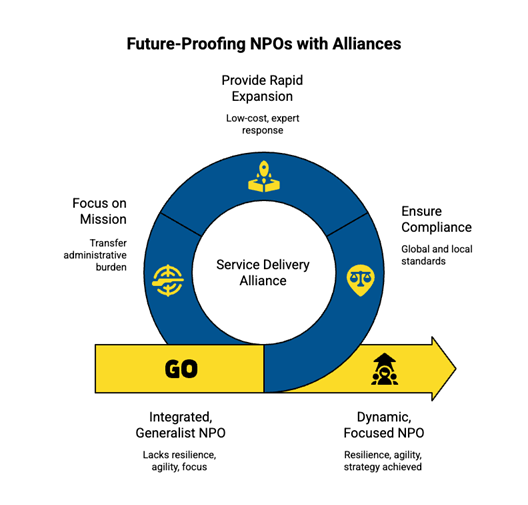
In the nonprofit sector, the decision to outsource non-core functions is not about giving up control. It is a strategic choice to focus an organisation’s energy and resources on its mission. It is about moving from a mindset of "we must do everything ourselves" to "we must only do what we, and only we, can do." This is the first step in building a symbiotic relationship with an external partner.
Choosing the right partner is crucial for a successful transition. This is not just a transactional relationship; it is a partnership for impact.
The decision to outsource requires a significant internal change. This is not about cutting jobs; it is about strategically reallocating talent.
Over the course of this series, we have explored the strategic choices before a nonprofit and the adaptable operational models that make them possible. We have seen that a mission built for endurance, for a seasonal sprint, or for strategic hibernation each requires a clear-eyed understanding of its purpose. The common thread is that the most impactful nonprofits are not defined by the size of their internal teams but by the efficiency with which they channel resources toward their mission. Partnering with external experts for non-core functions is a powerful way to achieve this. By embracing this strategic approach to their operational backbone, nonprofits can ensure that their work is not only impactful, but also strategically sound.