Let's Talk!
Our multidisciplinary team combines deep industry expertise with proven methodologies to deliver transformational outcomes. We partner with ambitious organizations to unlock sustainable growth and operational excellence.

The Architect, The Sprinter, and The Bear
In our first article, we explored how nature's strategic models; the long-enduring redwood, the seasonal flower, and the hibernating bear provide powerful metaphors for nonprofit missions. The key takeaway was that an organisation's operational structure must be as adaptable as its purpose. Now, let's delve into the practical realities of what it takes to build a mission to last, to sprint, or to strategically rest.
In the natural world, the mighty redwood is a masterpiece of resilience. Its strength lies not just in its trunk but in its root system, which intertwines with its neighbours to create a forest that can withstand the fiercest winds. A long-haul mission must be built on the same principles. It's not enough to be strong on your own; you must be part of a resilient ecosystem.
For an organisation intended to last for generations, endurance is built on a strong, flexible operational foundation. A key element is building strategic reserves. A robust reserve fund isn't a sign of hoarding; it's a strategic asset that provides the financial "breathing room" to weather economic storms, adapt to changing landscapes, and seize unexpected opportunities.
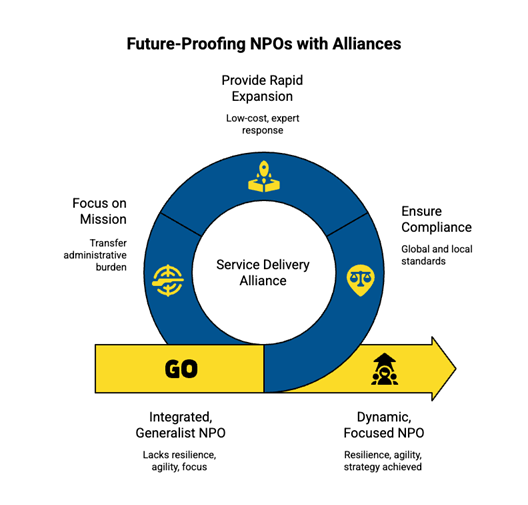
Endurance also comes from strategic alliances. Just as the redwood's roots intertwine, nonprofits can form powerful partnerships to share resources and streamline operations. For a long-term mission, these alliances are permanent fixtures, strengthening the organisation's core. In this model, the balance is typically a mix of internal staff for core strategic functions and outsourced support for non-core, administrative tasks.
Not every mission is a marathon. Some are like the seasonal flower designed to fulfil a specific, urgent purpose before completing their cycle. For these organisations, the greatest success is not longevity, but impact in a defined timeframe. The operational strategy must be built for maximum velocity and efficiency.
For a seasonal mission, community and funder engagement is the lifeblood. The focus is on a rapid mobilisation of support for a solvable problem. This requires a powerful narrative and clear calls to action. This rapid growth can be supercharged by network effects, making the service more valuable as more people use it.
In this model, the operational balance shifts significantly. The need for speed and temporary scaling makes relying on internal staff for every function inefficient. Here, outsourced shared services become a critical tool, allowing the organisation to scale up quickly for maximum impact without the burden of building a large, permanent internal team.
In the natural world, a bear doesn't retreat in defeat; it enters a period of strategic rest. This provides a powerful model for nonprofit organisations that face cyclical or periodic challenges. The question is not whether a nonprofit can survive, but whether it can strategically "hibernate" scaling down operations and conserving its core intellectual capital during quiet periods, only to reawaken when the need is great once again.
To achieve this, an organisation needs to be built with an emphasis on adaptability. The balance between internal and outsourced capacity is at its most variable here. A healthy reserve fund isn't just for a "rainy day" it's for the "quiet season," allowing an organisation to protect its mission and leadership expertise during periods of low activity.
When a mission goes dormant, the internal team can be reduced to a small core, with non-core functions handled entirely by outsourced shared services. This allows the organisation to dramatically cut costs and avoid the painful process of laying off permanent staff, while retaining the ability to spring back into action with the support of its external partners.
Regardless of whether a mission is a marathon, a sprint, or a cycle, the common thread is adaptability. The right operational model is the one that empowers the mission, not one that burdens it. The key is to understand that the balance between internal and outsourced capacity is a strategic choice. A mission built for endurance may have a larger internal team, a seasonal mission will rely more heavily on external support for its sprint, and a mission built for hibernation can seamlessly shift its operational model to suit its needs.
By embracing this flexible and strategic approach to their operational backbone, nonprofits can ensure that their work is not only impactful, but also strategically sound.